At a Glance
What Is a Watershed?
The land catchment area that drains into the lake. Rain and snowmelt — from rooftops, lawns, or forest — flow downhill into the lake.
New London Votes for Watershed Management Plan
By a landslide (258-2), voters at the March 18th New London Town Meeting approved Warrant Article 3. This authorizes the town to apply for funds with PLPA to create a Watershed Management Plan (WMP) for Pleasant Lake. The watershed management plan will be designed to reduce cyanobacteria (harmful algal blooms) in our lake. Alarming cyanobacteria blooms in Pleasant Lake were seen in both June and September last year.
Cyanobacteria (sometimes called blue-green algae) are tiny organisms that naturally live in lakes, but when conditions are right — think warm temperatures and excess nutrients like phosphorus washing in from the surrounding land — they can multiply into large, sometimes toxic blooms. These blooms can make the water unsafe for swimming, harm pets and wildlife, and generally turn a beautiful lake into something you'd rather admire from a distance.
So where does all that extra phosphorus come from? A little bit of everything in the watershed: stormwater runoff from roads and driveways, aging septic systems, lawn fertilizers, and erosion from shorelines and stream banks. Each source on its own might seem small, but together they add up, and the lake is the final destination for all of it.
That's where a Watershed Management Plan comes in. Think of it as a practical playbook for the whole community. It identifies exactly where the biggest nutrient sources are, then lays out specific steps, like upgrading stormwater infrastructure, improving septic maintenance, restoring natural buffers along the shore, and reducing erosion, to cut down the amount of phosphorus reaching the lake. Instead of guessing, the community gets a science-backed strategy, with a list of projects to address, and clear priorities.
Keeping the phosphorus out of the water ensures that Pleasant Lake stays safe for swimming, supports a healthy fish population, and maintains the property values that keep New London thriving. After all, nobody wants to rename it "Somewhat Unpleasant Lake."
A Long Road Ahead and Steps to Take Now
New London will submit the Watershed Management Plan funding proposal to the NH CWSRF program by June 1, 2026. The CWSRF typically announces final funding decisions in the fall. Funding becomes available the next spring.
If our request is approved, by late spring of 2027 New London would solicit bids from firms qualified to produce EPA-compliant plans. Work on the plan could then start during the summer of 2027. Because plans of this kind typically take about 18 months to complete, even if every step goes smoothly we shouldn't expect a finished plan much before 2029.
The good news is that we don't have to wait until then to act. Steps to reduce phosphorus entering a lake are well known and easy to take. Neighboring lake protective associations, particularly the Lake Sunapee Protective Association, are much further along the watershed-management path and eager to share what they've learned. The sooner we begin limiting phosphorus inputs to Pleasant Lake, the sooner we reduce the risk of further cyanobacteria outbreaks.
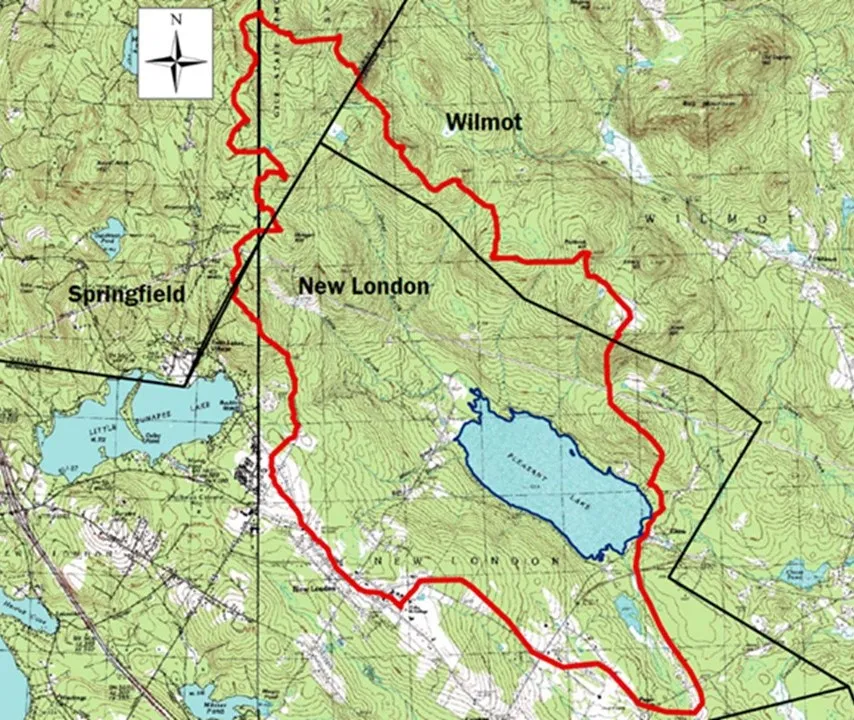
Pleasant Lake's watershed is highlighted in red on the map below.
Colby-Sawyer College Watershed Study
Colby-Sawyer College's 2024-2025 assessment identified nutrient sources, land use patterns, and priority areas in the Pleasant Lake watershed. This study shapes our current conservation priorities.
Everything Connects
A Studied Watershed
Why It Matters Now
Failing or Aging Septic Systems
Failing or rarely pumped septic systems leach phosphorus and nitrogen into groundwater that flows to the lake — often invisibly.
Lawn Fertilizers & Chemicals
Phosphorus-containing fertilizers applied to lawns, gardens, and landscaping wash off during rain events and flow into the lake through stormwater runoff. Even small amounts can fuel significant algal and cyanobacteria growth — particularly in a lake as sensitive as Pleasant Lake.
Road Salt & Stormwater Runoff
Impervious surfaces concentrate runoff to the lake. Minimize the use of de-icing salts on roads, driveways, and walkways that pollute the lake and that can kill the good zooplankton that eat cyanobacteria.
What You Can Do
Everyone who lives near or enjoys Pleasant Lake can be a good lake steward.
Town Ordinances
Pleasant Lake's local ordinances govern fireworks and shoreline activities. Review the current rules before planning lakefront projects or recreation events.
Maintain Your Septic System
Pick Up Pet Waste
Plant a Shoreline Buffer
Go Fertilizer-Free
Manage Erosion & Runoff
Join the Lake Smart Program
Know Local Ordinances
Nutrient Filtering
Native plants absorb phosphorus and nitrogen before runoff reaches the water. Deep roots hold soil and reduce erosion.
Wildlife Habitat
Critical habitat for birds, amphibians, pollinators, and aquatic wildlife — food, cover, and breeding sites lawns can't provide.
Bank Stabilization
Grass has shallow roots. Native plantings anchor soil, reduce erosion, and protect shoreline stability.